Rave Culture 101
What Is Rave Culture?
Rave culture is the community, music, and set of shared values that grew up around electronic dance music and all-night dance parties. It runs on four ideas, shortened to PLUR: Peace, Love, Unity, and Respect. What started as secret warehouse parties in the 1980s is now a global scene of festivals, clubs, and traditions like kandi trading that ravers pass down to whoever shows up next.
That is the short version. The longer one is more fun, so keep reading. This is Rave 101, the stuff nobody hands you at the gate.
Where Rave Culture Started
Raves began to emerge in the 1980s as secret dance parties that usually happened after hours in metropolitan cities. No official venue. No advertising. You found out through a friend of a friend, and the address showed up a few hours before doors. During those humble beginnings, the philosophy of PLUR was created, and it is still present to this day.
Frankie Bones, a legendary DJ from New York City, coined the term to describe something he was already watching happen on the floor. He was not writing a rulebook. He was naming a behavior that a few hundred people in a warehouse had figured out on their own.
What Does PLUR Mean?
PLUR stands for Peace, Love, Unity, and Respect, the core principles that rave culture is built on. Raving is about celebrating a love for dance, music, and self-expression, and PLUR is the shorthand for how that gets done without anybody getting stepped on.
Four words. That is the whole philosophy. It fits on a bracelet, which is exactly the point.

But What Is PLUR, Really?
PLUR is embedded in rave culture and it is the foundation of what raving looks like today. Raves have been adopted by the mainstream, and the scene has evolved into something much greater and more inclusive than it once was.
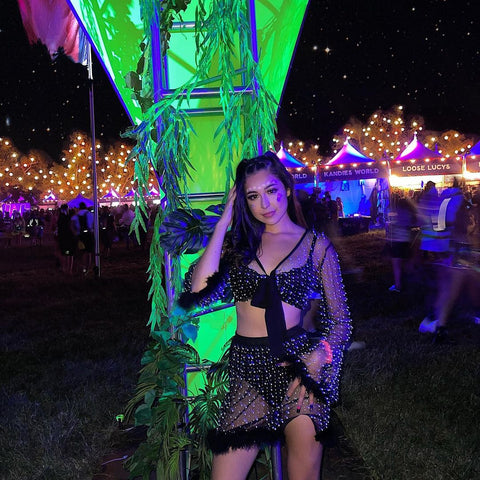
But here is the part that matters. At a rave, it is the people who give PLUR meaning. Not the lineup, not the production budget, not the stage. It shows up in small moments. Somebody hands you water when you look overheated. A stranger notices you got separated from your group and waits with you until you find them. Nobody films the person having a rough moment. Bring good vibes, come prepared to be part of it, and the rest takes care of itself.

@jennifer_jimenez

EDM Culture and the Rave Community Today
The popularity of EDM festivals has skyrocketed thanks to the PLUR rave vibes that make them what they are, and that growth pushed electronic music itself forward. Rave subculture is huge now. Massive. But the ethos of the events is still true to rave culture's roots.
There are more genres and sub-genres of electronic music than any one person can keep straight, which is a feature and not a problem. House, techno, dubstep, drum and bass, trance, hardstyle, and about forty things that live in between. Somewhere in there is the sound that makes sense to you. Most people find it by accident, wandering into the wrong tent at the right time.


Lightning Flash Reflective Outfit
Raves have a way of bringing people together in ways that are genuinely hard to explain to anyone who has not been. You will see people from every walk of life getting along and appreciating one another. Different jobs, different cities, different ages by a couple of decades. No matter how different we are, PLUR is the common thread that binds all of it together. And that goes for everyone on the floor, which is why our men's rave clothing collection matters as much as anything else we make.

@k_shaww on Instagram

Augmented Reality Reflective Outfit

What Are Raves Like?
Loud, warm, and friendlier than you are expecting. A rave is a few thousand people who all decided to be in the same room for the same reason, and that shared reason does something to a crowd. The lights go down, the first drop lands, and the room stops being a room full of strangers.
Practically speaking: expect long sets, a lot of walking, and temperatures that swing hard between a packed tent and an open field at 2 a.m. Expect to lose your friends at least once. Expect to make new ones while you look for them. If it is your first one and you are still working out what to bring, our guide on what to wear to a rave covers the practical side.
Kandi: The Rave Tradition Everyone Asks About
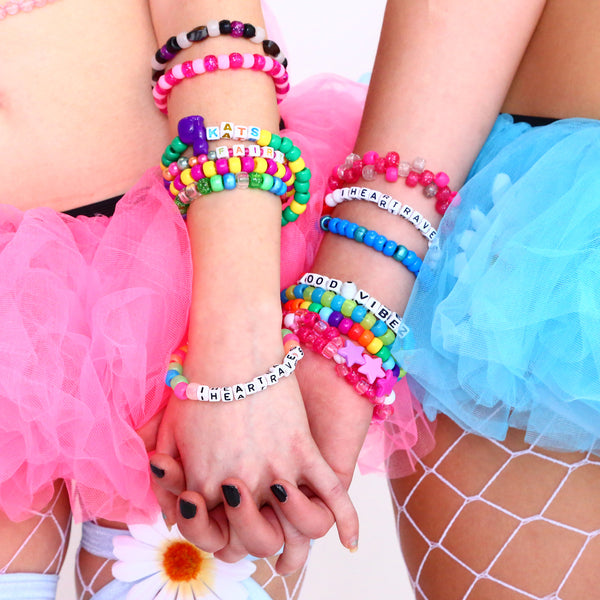
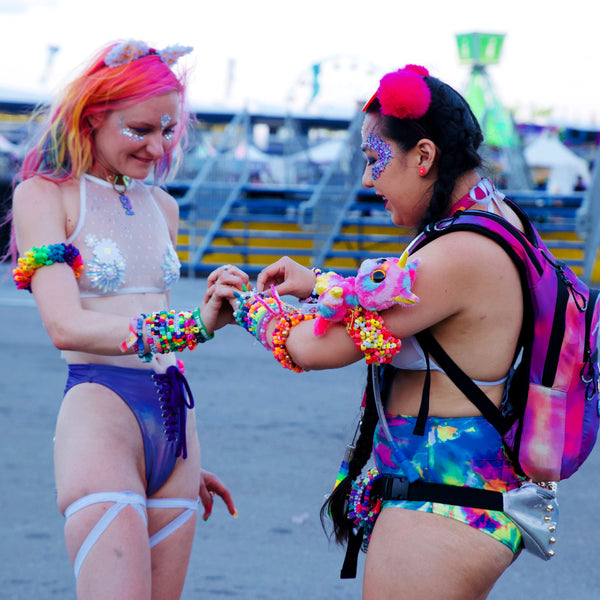
The idea of PLUR resonates with ravers, and one of the main ways the community celebrates it is by trading kandi. Kandi are colorful beaded bracelets, usually handmade, often carrying a short message or a small charm. They are cute. They are also not really about being cute.
Each piece of kandi you trade comes with a story and marks a specific moment you shared with somebody during the night. To trade, you each do a handshake, and the handshake spells out the mantra: Peace, Love, Unity, Respect. Peace is a peace sign. Love is half a heart from each of you. Unity is hands clasped. Respect is fingers laced, and the bracelet slides from one wrist to the other.
It takes about eight seconds. People remember them for years.
Rave Culture in 2026
Are the raves we see today what the founders had in mind? Hard to say, and probably not entirely. But the scene we ended up with is a good one. The EDM community is beautiful, vibrant, and thriving, and it is bigger now than anybody standing in a Brooklyn warehouse in 1992 could have predicted.
This ever-growing rave community has passed the traditions down deliberately. That is the interesting part. Nobody enforces PLUR. There is no committee. It survives because experienced ravers keep showing first-timers how it works, one kandi trade and one shared water bottle at a time. For a lot of people, PLUR stopped being a concept a long time ago and turned into a way of moving through the world, where the goal is simply to be a more compassionate and understanding person.
That is rave culture. Not the lasers. The people under them.
Rave Culture 101: Common Questions
What is rave culture?
Rave culture is the community and value system built around electronic dance music events. It is defined by PLUR (Peace, Love, Unity, Respect), self-expression through rave fashion, and shared traditions like trading kandi bracelets.
What does PLUR stand for?
PLUR stands for Peace, Love, Unity, and Respect. DJ Frankie Bones popularized the term in the early 1990s to describe the code of conduct he saw forming in the underground dance scene.
When did rave culture start?
Rave culture emerged in the 1980s through underground after-hours dance parties in major cities, with roots in Chicago house and Detroit techno. It spread to the UK and back across the United States through the early 1990s, and moved into the mainstream festival era in the 2010s.
What is kandi and why do ravers trade it?
Kandi are handmade beaded bracelets that ravers trade as a gesture of connection. The trade is done through a four-step handshake representing Peace, Love, Unity, and Respect. Each bracelet marks a specific moment shared with a specific person, which is why ravers keep them for years.
What do people wear to raves?
Rave outfits prioritize comfort, breathability, and self-expression: bodysuits, two-piece sets, mesh layers, reflective pieces, platform shoes, and accessories like rave glasses and clack fans. There is no dress code. The only real rule is wearing something you can dance in for six hours.
Is rave culture still alive today?
Yes, and it is larger than it has ever been. Festivals like EDC, Ultra, and Beyond Wonderland draw hundreds of thousands of attendees a year, while underground warehouse and club scenes continue in cities worldwide. The scale changed. The PLUR ethos did not.
What To Wear To A Rave? Next ->
Published by Angela Le
Last Updated: 8/10/2026